best review thus far with excellent pictures
Extra-corporeal Membrane Oxygenation (ECMO)
Review from the NEJM (NEJM 2011;365(20):1905) If you bypass lung entirely, it has no way to get CO2 becomes alkalotic and may infarct If V/A then heart must pump against the pressure gradient introduced into the aorta You know when there is no native CO because there will be a straight arterial pressure tracing just showing a mean pressure Pulmonary pressure from a hyperdynamic right heart will overcome hypoxic vasoconstriction Oxygen is flow dependant Muscle/kidney/Liver clear lactate ECMO works by sending blood through artificial lung either membrane or hollow fiber. Blood flows counter-current to gas Rated flow of a membrane is how much blood can be raised from 75% to 95% O2 sat in a given time Maintain Activated clotting time of 180-200 Study of crash bypass for cpr-nonresponsive cardiac arrest (Inten Care Med 2007;33:758) CESAR trial shows cost effectiveness for transfer to ECMO center if severe resp fx (Lancet 2009; 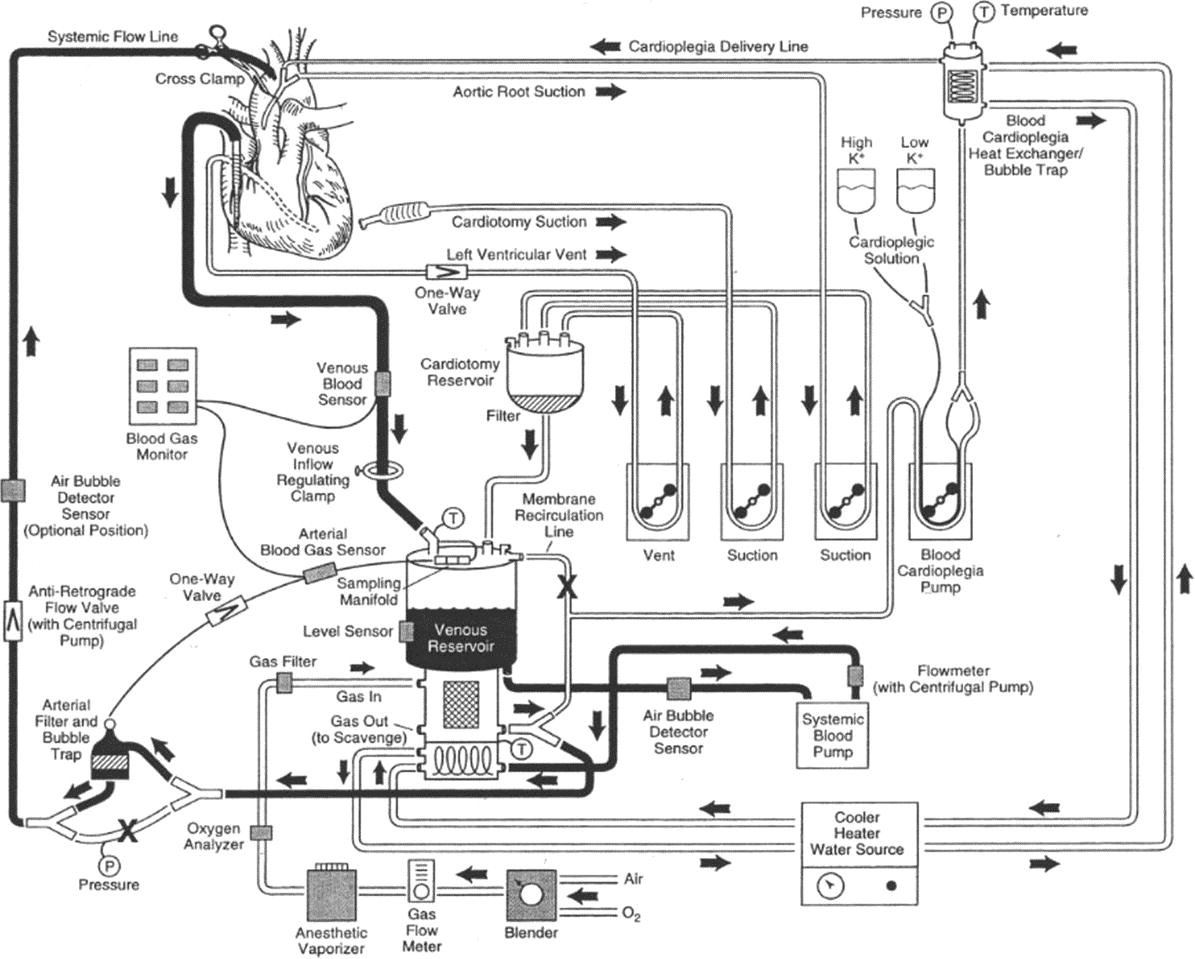
 venovenous bypass review When you put a person on cardiopulmonary bypass despite being on full > cardiopulmonary bypass defined as diversion of all systemic venous > return to the oxygenator, there is sufficient amount of noncoronary > collateral and other flow to the heart which will fill the heart (for > eg bronchial flow etc). This will normally be ejected by the heart and > the left ventricle will be kept empty. Now if the heart is asystolic > or fibrillating it cannot kick out this volume into the aorta and so > the heart will now distend and as per Laplaces law with increasing > radius there will be increasing wall tesnions (to put it in simplistic > terms it becomes increasingly difficult to distend a baloon as it > enlarges and the wall tension will be higher) . This implies that > wall tesnion wll increase and with increasing distention the wall > tension will increase and thus decrease progressive subendocardial > perfusion and at one stage there will be no subendocardial myocardial > perfusion , a condition which is practically worse while not > externally visible. This distention is negated by ‘venting” ie a > placing another cannula or catheter to collect this excessive return > and divertting it away from the left ventricle , be it by direct > incision on the ventricle (less often used today ) or by indirect > methods ranging from the aorta to the pulmonary artery (based on the > fact that it is a valveless circuit after the pulmonary valve).(I can > go on further (as this is a very important topic in CPB > pathophysiology) but to make a long story
short – you need to have the > heart empty and beating for it to function well. If it cannot beat > prevent it from distending by approproate venting. At times we > actually have to squeeze the heart and empty it and prevent > distention. A term which is we refer to as “Theri haath me Jagannath” > meaning (roughly translated that “the Lord is in your Hands” to > emphasize that the lfie of the patient depends on you preventing > distention (and actually is a vulgar joke (( you could get it 😉 )) > Prasanna | | |